
The Center for Education and Research in Information Assurance and Security (CERIAS)
The Center for Education and Research inInformation Assurance and Security (CERIAS)


[tags]Windows, Office, malware, vulnerabilities[/tags]
This appeared in USA Today yesterday: Cyberspies exploit Microsoft Office. This is yet more support for my earlier post.
So, are you ready to join the movement -- stop sending Word documents in email?
Update 4/28: And here is yet another story of how Word files are being used against victims.
[posted with ecto]
I’ve spent some of my down time in the past couple weeks working with the NIST NVD data to get stats on PHP application vulnerabilities. What follows is a breakdown of the 20 PHP-based applications that had the highest aggregate vulnerability scores (NIST assigns a score from 1-10 for the severity of each entry), and the highest total number of vulnerabilities, over the past 12 months. Of the two, I feel that the aggregate score is a better indicator of security issues.
A few caveats:
Without further ado, here are the tepid Excel charts:
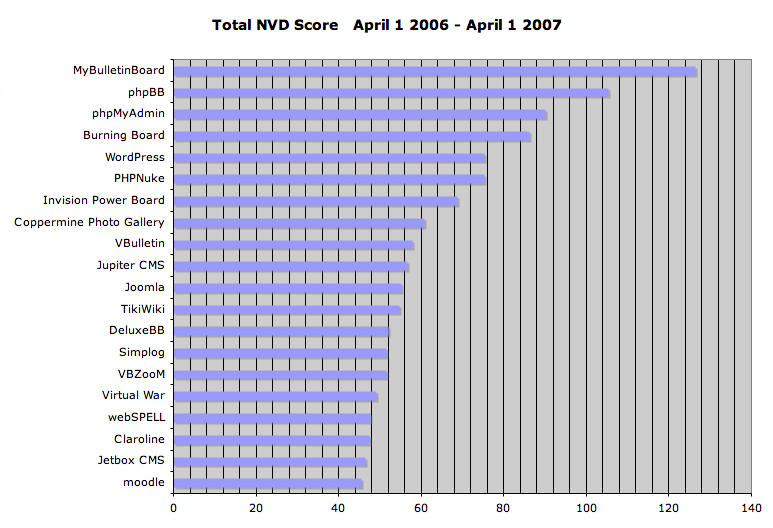
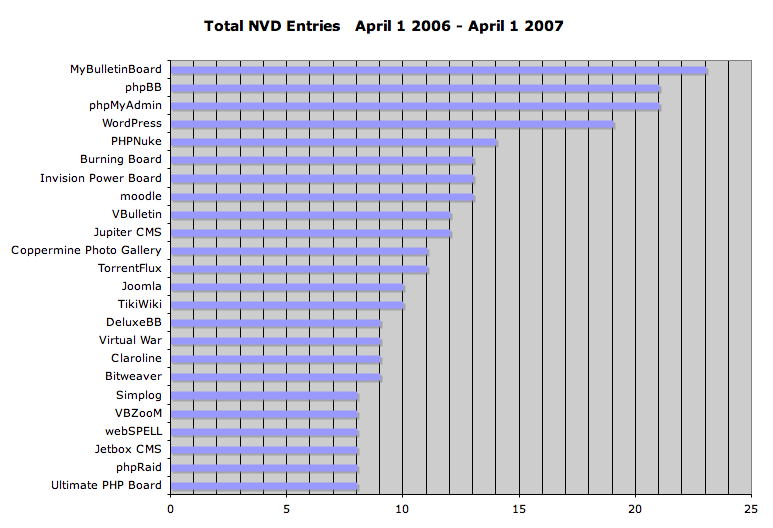
A couple notes:
I do intend to keep this data up-to-date if people find it interesting, so let me know if you’d like me to do so, or if you’d like to see other types of analysis.
[tags]php, security, application security, vulnerabilities, nist, nvd, statistics[/tags][tags]Vista, Windows, security,flaws,Microsoft[/tags]
Update: additions added 4/19 and 4/24, at the end.
Back in 2002, Microsoft performed a “security standdown” that Bill Gates publicly stated cost the company over $100 million. That extreme measure was taken because of numerous security flaws popping up in Microsoft products, steadily chipping away at MS's reputation, customer safety, and internal resources. (I was told by one MS staffer that response to major security flaws often cost close to $1 million each for staff time, product changes, customer response, etc. I don't know if that is true, but the reality certainly was/is a substantial number.)
Without a doubt, people inside Microsoft took the issue seriously. They put all their personnel through a security course, invested heavily in new testing technologies, and even went so far as to convene an advisory board of outside experts (the TCAAB) -- including some who have not always been favorably disposed towards MS security efforts. Security of the Microsoft code base suddenly became a Very Big Deal.
Fast forward 5 years: When Vista was released a few months ago, we saw lots of announcements that it was the most secure version of Windows ever, but that metric was not otherwise qualified; a cynic might comment that such an achievement would not be difficult. The user population has become habituated to the monthly release of security patches for existing products, with the occasional emergency patch. Bundling all the patches together undoubtedly helps reduce the overhead in producing them, but also serves to obscure how many different flaws are contained inside each patch set. The number of flaws maybe hasn't really decreased all that much from years ago.
Meanwhile, reports from inside MS indicate that there was no comprehensive testing of personnel to see how the security training worked and no follow-on training. The code base for new products has continued to grow, thus opening new possibilities for flaws and misconfiguration. The academic advisory board may still exist, but I can't find a recent mention of it on the Microsoft web pages, and some of the people I know who were on it (myself included) were dismissed over a year ago. The external research program at MSR that connected with academic institutions doing information security research seems to have largely evaporated -- the WWW page for the effort lists John Spencer as contact, and he retired from Microsoft last year. The upcoming Microsoft Research Faculty Summit has 9 research tracks, and none of them are in security.
Microsoft seems to project the attitude that they have solved the security problem.
If that's so, why are we still seeing significant security flaws appear that not only affect their old software, but their new software written under the new, extra special security regime, such as Vista and Longhorn? Examples such as the ANI flaw and the recent DNS flaw are both glaring examples of major problems that shouldn't have been in the current code: the ANI flaw is very similar to a years-old flaw that was already known inside Microsoft, and the DNS flaw is another buffer overflow!! There are even reports that there may be dozens (or hundreds) of patches awaiting distribution for Vista.
Undoubtedly, the $100 million spent back in 2002 was worth something -- the code quality has definitely improved. There is greater awareness inside Microsoft about security and privacy issues. I also know for a fact that there are a lot of bright, talented and very motivated people inside Microsoft who care about these issues. But questions remain: did Microsoft get its money's worth? Did it invest wisely and if so, why are we still seeing so many (and so many silly) security flaws? Why does it seem that security is no longer a priority? What does that portend for Vista, Longhorn, and Office 2007? (And if you read the “standdown” article, one wonders also about Mr. Nash's posterior. :-) )
I have great respect for many of the things Microsoft has done, and admiration for many of the people who work there. I simply wish they had some upper management who would realize that security (and privacy) are ongoing process needs, not one-time problems to overcome with a “campaign.”
What do you think?
[posted with ecto]
Update 4/19: The TCAAB does still continue to exist, apparently, but with a greater focus on privacy issues than security. I do not know who the current members might be.
Update 4/24: I have heard (informally) from someone inside Microsoft in informal response to this post. He pointed out several issues that I think are valid and deserve airing here;
Many of my questions still remain unanswered, including Mr. Nash's condition....